
Last updated November 2, 2026
 Wrought iron
 Wood & steel frame
 Farm & ranch
 Sliding driveway gates
 LiftMaster operators
Free on-site gate assessment - hinges, posts, and your LiftMaster or Nice gate operator checked before anything is quoted
The assessment is free and the quote is the invoice.
Get your free estimateGate Repair Troubleshooting: Common Problems and How to Fix Them
Here’s the thing most gate trouble guides won’t tell you: a gate that stops halfway open is rarely a motor problem. We’ve lost count of how many times a homeowner in Escondido has replaced a perfectly good LiftMaster operator because a photo eye was knocked out of alignment by a weed trimmer. That’s a six-hundred-dollar mistake born from chasing symptoms instead of following the signal path. This guide – along with our Gate Repair Warning Signs: An Escondido Homeowner’s Reference Guide – teaches you the diagnostic logic our technicians use daily, from the moment power leaves the breaker to the final click of the limit switch, so you can pinpoint whether the fault is electrical, mechanical, or user error before spending a dollar.
Quick Answer
Gate repair troubleshooting means walking the signal path in order: power source first, then control board, then operator, then safety devices and mechanical hardware. The four most common failure modes are a gate that won’t open, won’t close, reverses mid-cycle, or runs sluggishly, and each traces back to a knowable fault: dead batteries, misaligned photo eyes, worn limit switches, broken safety loops, or capacitor failure. Most issues can be narrowed to one component in under ten minutes using the LED diagnostic codes on your control board, which LiftMaster, DoorKing, and Viking all build into their systems.
Styles & brands we work with
- Wrought iron
- Wood & steel frame
- Farm & ranch
- Sliding driveway gates
- LiftMaster operators
Table of Contents
- The Signal Path Method: How Gate Technicians Actually Diagnose Problems
- Gate Won’t Open: The Six Causes in Priority Order
- Gate Won’t Close: Safety Sensors, Loops, and Force Settings
- Gate Reverses Unexpectedly Mid-Cycle
- Gate Moves Slowly or Strains Under Load
- How to Read LED Diagnostic Codes on LiftMaster, DoorKing, and Viking Control Boards
- Loop Detectors and Why Escondido Pavement Cracks Matter
- When the “Repair” Keeps Coming Back: Calibration and Installation Root Causes
- Common Mistakes to Avoid
- When to Call a Professional
- Frequently Asked Questions
The Signal Path Method: How Gate Technicians Actually Diagnose Problems
Most homeowners troubleshoot backwards. They see a gate that won’t budge and immediately suspect the motor, because the motor is the biggest, most obvious component. Then they spend an afternoon testing a motor that was never the issue. Trained gate technicians work the opposite way, tracing the electrical and mechanical signal from its origin to its end point, and the method works regardless of whether you have a Viking slide gate operator or a Ghost Controls swing arm.
Here’s the sequence every dedicated gate specialist follows, and the one you should adopt before touching anything:
- Confirm power at the source. Check the breaker, the GFCI outlet, the disconnect switch. In Escondido, we’ve seen August heat waves trip thermal overloads on outdoor breakers that feed gate operators, killing power to the whole system when air conditioners strain the circuit.
- Check the control board for power. If the board has no lights, you have a power delivery problem, not an operator problem. If lights are on but flashing a pattern, you have a diagnostic code and the board is telling you exactly where to look.
- Test operator function. With power confirmed and codes interpreted, use the manual release or test button to see if the operator responds to direct commands at the board. If it does, the fault lies downstream, in safety devices or wiring.
- Check safety devices. Photo eyes, safety edges, and loop detectors sit between the control board and actual gate movement. A fault here blocks the signal even when the board and operator are healthy.
- Inspect mechanical components last. Hinges, wheels, track, chain, and the gate leaf itself. Only after everything upstream checks out do mechanical faults become the primary suspect.
This order exists for a reason. Electrical faults present like mechanical problems and vice versa. A gate that strains may have a dying capacitor, not a bent hinge. By walking the path in this sequence, you eliminate the most likely faults first and avoid replacing expensive parts that were never broken.
Gate Won’t Open: The Six Causes in Priority Order
When a gate refuses to open, the frustration is immediate. You’re either locked inside your own driveway or unable to get in. Before calling anyone, work through these causes in order, because the most common fix is also the cheapest.
- Dead remote battery or wiped transmitter code. This is the number one culprit by a wide margin. Replace the battery first. Then check whether the transmitter LED lights up when you press the button. If it does and the gate still won’t respond, the receiver may have lost its programmed code, a common issue after power surges that are frequent in Escondido during monsoon-season lightning storms.
- Keypad failure or incorrect code entry. The keypad may have a dead internal battery, corroded contacts, or simply need reprogramming. If you have a Linear or DoorKing keypad, the LED behavior on keypress tells you a lot. No LED means no power to the keypad. Rapid flashing usually means a wrong code or a locked-out keypad after too many failed attempts.
- Photo eye obstruction or misalignment. A misaligned or dirty photo eye will prevent opening on many systems, not just closing. If anything is blocking the beam, including spider webs or a fallen palm frond, the gate stays put. In Escondido, where many driveways border native scrub, branches and debris drift into the beam path regularly.
- Tripped breaker or blown fuse. If the outlet that feeds the operator has power but the board is dark, the fault may be a blown fuse on the control board itself, not the breaker. Some systems use inline fuses inside the operator housing.
- Loop detector constantly triggered. If an entry or safety loop is shorted or sending a constant detection signal, the board thinks a vehicle is always present and may lock out open commands. We see this on Escondido properties where pavement has shifted or roots have grown under the driveway and severed the loop wire.
- Failed operator motor or capacitor. Only after the first five causes are ruled out should you suspect the operator. A burned-out motor usually smells hot and will not respond to any input, including the manual test button.
For most homeowners, the fix lands at step one or two. And if your gate is a slide gate with a chain drive, a broken chain is so visually obvious that you’d notice it before running any diagnostics.
Gate Won’t Close: Safety Sensors, Loops, and Force Settings
A gate that opens but refuses to close is the single most common call we get in Escondido, and in most cases the gate is working exactly as designed. Closing is the dangerous direction. The system is programmed to refuse closure if any safety device reports an obstruction, and that refusal is the control board protecting someone from getting crushed.
Here are the failures that trigger the refusal, in the order we find them:
- Misaligned or dirty photo eyes. The most common cause. If the receiver’s LED is blinking instead of steady, the beam is not reaching it. Align the sensors, wipe the lenses with a dry cloth, and verify the LED returns to solid.
- Obstruction in the gate’s path. A rock, a child’s bicycle, a garbage can, or a plant that has grown into the track or swing arc. The gate doesn’t know the difference between a car and a trash bin.
- Malfunctioning safety edge. The pressure-sensitive strip on the leading edge of the gate may be worn, cracked, or internally shorted. A shorted edge tells the board an obstruction is being touched constantly, which blocks closure.
- Loop detector signaling a phantom vehicle. A failure in the safety loop under the gate’s path can keep the exit or reverse loop permanently triggered, preventing closure. This failure often follows driveway resurfacing or seismic settling, both of which happen across Escondido’s hillside neighborhoods.
- Force settings set too low. If the gate closes an inch and reverses, the board may interpret the gate’s own weight as resistance. This is a calibration issue, not a hardware failure, and it’s why replacing the operator wouldn’t help. The force limits need adjustment downward or the obstruction detection needs recalibration.
The trap here is assuming a failing component. A surprising percentage of “won’t close” calls end with an adjustment to the force trimpots or a realignment of a photo eye bracket, not a replacement part.
Gate Reverses Unexpectedly Mid-Cycle
A gate that opens halfway and then reverses direction, or closes a few feet and bounces back, is typically signaling a safety event. But the “event” isn’t always real. Intermittent reversal, the kind that happens once in five cycles, is one of the most frustrating gate failures to diagnose because the board is reacting to a signal you may not be able to see.
The causes break into three categories:
- Intermittent safety device faults. A photo eye that vibrates out of alignment as the gate moves past it, a safety edge wire with a frayed insulation that shorts only when flexed at a specific position, or a loop detector that drops signal for a millisecond when a car passes over a cracked section of driveway. These are the hardest to catch because they don’t leave a persistent code.
- Travel module or limit switch failure. Older operators use physical limit switches that wear out, and as they degrade they can tell the board the gate has reached its limit when it hasn’t, triggering a reversal. Newer Viking and DoorKing boards use magnetic limits or encoder counts, which fail differently but still produce mid-cycle reversals when the reading is corrupted.
- Inadequate power supply. If line voltage sags under load, often because the operator shares a circuit with other equipment, the motor can stutter and the board can misread the gate position. In older Escondido homes with undersized panels, a pool pump cycling on can momentarily starve the gate circuit and cause one-off reversals.
The correct diagnostic starts with observing the reversal point. Does it always happen at the same spot? That’s a physical limit or wiring fault at a specific flex point. Does it happen at random points? That’s more likely a power supply or intermittent sensor issue. Write down where the gate is when it reverses before you call anyone, because that observation saves a technician significant time.
Gate Moves Slowly or Strains Under Load
Sluggish gate movement is rarely the motor’s fault. More often, the motor is working harder than it should because something downstream is adding resistance, or the motor isn’t receiving the current it needs to perform at full torque.
Here’s how to think about a slow gate:
- Capacitor failure. Most single-phase gate operators use a start and run capacitor to give the motor its initial torque. A failing capacitor delivers reduced starting power, so the gate labors to move and may stall on the first attempt. If you hear a hum from the operator but the gate doesn’t move until you give it a push, that’s a classic capacitor symptom, not a motor symptom.
- Mechanical drag. On slide gates, the track and rollers accumulate grit, especially on Escondido properties near unpaved driveways or after the Santa Ana winds blow fine silt into every bearing surface. On swing gates, the hinges take the load of the entire leaf, and when they sag, the gate drags against the ground and fights the operator.
- Low line voltage. If the wire run from the panel to the operator is undersized or the circuit is shared with another load, voltage drops under the motor’s starting draw and the gate moves slowly or intermittently. This is common on long driveways where the operator sits far from the house panel.
- Worn drive chain or belt tension. A loose chain slips on the sprocket; a loose belt glazes and slips on the pulley. Both produce sluggish, jerky movement that gradually worsens.
One Escondido homeowner called us after replacing his own motor, only to find the new one was just as slow. The real problem was a bent track bracket that had been knocked loose by a delivery truck, adding enough drag to stall both motors. The bracket was a thirty-minute fix.
How to Read LED Diagnostic Codes on LiftMaster, DoorKing, and Viking Control Boards
Most homeowners don’t know that their control board has a built-in diagnostic display, but almost every modern residential and commercial gate operator includes one. The board is telling you what’s wrong. You just need to know how to listen.
Here’s how the three most common boards in Escondido communicate:
- LiftMaster boards use a single diagnostic LED that blinks in patterns. A steady glow means power is good and the board is idle. A blinking pattern, usually a sequence of long and short pulses, corresponds to a fault code printed on the wiring diagram inside the operator cover. Two blinks often indicates a photo eye issue; five or six frequently points to a motor or capacitor fault. LiftMaster also uses an audible beep pattern on some models for the same purpose.
- DoorKing boards are more explicit. The 9150 and 1601 series, common on apartment complexes across Escondido, include an LCD screen that displays plain-English messages like “ENTRAPMENT” or “MAG LOCK” or “AC POWER OFF.” The screen takes the guesswork out, but the relay and limit LEDs also fit into the diagnostic path if the screen is dark.
- Viking boards use a combination of status LEDs and a seven-segment display on newer units. Their boards typically have labeled LEDs for “OPEN,” “CLOSE,” “STOP,” and “SAFETY,” so you can see which input the board is receiving. If the “SAFETY” LED is lit while nothing is in the gate’s path, you’ve found your fault.
The key insight: don’t unplug the board or cut power before reading the code. A power reset will clear many momentary faults, but it also erases the evidence of an intermittent problem. Photograph the LED pattern or write it down before resetting anything. That single step turns a vague service call into a precise one.
Loop Detectors and Why Escondido Pavement Cracks Matter
Loop detectors are the invisible part of automatic gate systems, and when they fail, the symptoms look like almost anything else. A loop is a coil of wire buried in the pavement that detects the metal mass of a vehicle. When a car drives over it, the loop tells the control board to open or hold the gate. When the loop breaks, the system behaves unpredictably.
In Escondido, the loops are under constant stress. Our soil is expansive in many neighborhoods, particularly on hillsides and canyon-adjacent lots. The ground swells in winter and contracts in summer, and over a decade or two, that movement cracks pavement and stretches loop wires until they snap. We also see loop failures after heavy rain saturates crack fractures and corrodes the wire jacket.
What does a failed loop look like from the driver’s seat?
- The gate opens for you but won’t hold open, slamming into reverse mid-passage because the safety loop has stopped seeing your car.
- The exit loop fails and the gate refuses to open automatically when you pull up, even though the remote works fine.
- The gate stays open permanently because the board receives a constant “vehicle present” signal from a shorted loop.
The right fix is rarely splicing the old wire. Given Escondido’s soil movement, a properly installed replacement loop should be saw-cut deeply into fresh, stable pavement with a sacrificial spacer, not slipped into an existing crack. A loop that’s installed in the same fractured slab will fail the same way within a few years. This is a recurring problem on older Escondido estates we service, and it’s one of the clearest examples of why a gate specialist can’t just be a general repairman.
When the “Repair” Keeps Coming Back: Calibration and Installation Root Causes
Some gates develop a pattern: the same symptom recurs every few weeks or months, no matter what gets replaced. When that happens, the replacement part was often treating the symptom, not the root cause. In our experience in Escondido, recurring failures fall into three families:
- Improper installation geometry. A swing gate hung slightly out of level, or a slide gate mounted with the track at a fraction of a degree off horizontal, will constantly fight the operator. Hinges wear faster, chains stretch quicker, and capacitors fail sooner. We’ve diagnosed gates where the original installer shimmed the operator with a piece of plywood that rotted after one rainy season, throwing the whole driveline out of alignment.
- Undersized equipment. A gate operator rated for a 300-pound leaf installed on a 450-pound steel gate is going to work for a while, then wear out its motor and gears prematurely. The operator was never the problem; the spec was the problem. This shows up on heavier custom gates in Escondido neighborhoods where homeowners upgrade from wood to steel without upgrading the drive system.
- Missing or incorrectly configured safety devices. A gate that keeps reversing or faulting out may have a photo eye mounted at the wrong height, a safety edge wired into the wrong input, or force settings cranked too high to compensate for an underlying mechanical issue. Until the configuration and geometry are corrected, the board will keep throwing faults no matter how many new sensors go in.
The tell is a repair history that looks like whack-a-mole: a new capacitor, then a new limit switch, then a new photo eye, all within a year. None of those parts failed independently. They were all stress victims of a deeper installation or calibration problem. When you suspect that pattern, the most cost-effective move is a full system evaluation, not another part swap.
Common Mistakes to Avoid
- Replacing the motor before checking the safety devices. The motor is rarely the first thing to fail, but it’s the first thing homeowners suspect. Always walk the signal path before buying parts. We regularly see Gate Repair Escondido customers who’ve already replaced a perfectly good operator.
- Power cycling the board before reading the diagnostic code. A reset clears fault codes that would have pinpointed the problem. Photograph the LED pattern before you unplug anything.
- Adjusting the force settings to “fix” a dragging gate. Cranked-up force settings let the gate muscle through the resistance, but they also defeat the entrapment protection, which is the safety system that stops the gate from crushing someone. It’s a dangerous shortcut that masks the real problem.
- Using a pressure washer on the operator housing. Water intrusion kills control boards. Cleaning the gate with a pressure washer near the operator or photo eyes is a common cause of failures we see in Escondido after weekend cleanup projects.
- Ignoring recurring symptoms. A gate that reverses once a month will eventually fail completely, usually at the worst possible time. Intermittent faults are diagnoses waiting to happen, not gremlins to live with.
- Replacing a loop without addressing the pavement below it. A new loop in a cracked slab is a future failure. The pavement needs to be stable before the wire goes in, or the problem returns on a cycle.
- Skipping routine hinge and track lubrication. Mechanical components wear faster when they run dry, especially in Escondido’s hot, dusty summers. A few minutes of maintenance twice a year prevents many mechanical failures entirely.
When to Call a Professional
Some gate repairs are homeowner-friendly: a remote battery, a photo eye alignment, a tripped breaker. But the line where DIY becomes risky sits at anything involving the operator’s high-voltage connections, the control board wiring, or the structural hardware of the gate itself. A falling gate leaf weighs hundreds of pounds, and an energized capacitor can deliver a dangerous shock even when the power is off. If you’re diagnosing a fault that involves line voltage, safety device wiring, or any mechanical component that holds the gate’s weight, call a trained technician instead of probing further. Gate Repair Escondido offers free estimates across Escondido, from the hillside properties above Lake Hodges to the flat lots west of Centre City, and we’ll give you an honest read on whether a part swap or a full evaluation is the right call. Reach us at (833) 630-4122.
Frequently Asked Questions
The most common cause of intermittent operation is a weak remote battery combined with an aging receiver, but intermittent faults also come from photo eyes that vibrate out of alignment, loop wires that short only when a car passes over a specific cracked spot, or a control board that’s receiving borderline voltage. Because the fault is transient, the board often won’t store a code, which is why you should note exactly when and where the failure happens before calling for service.
How much does a gate operator replacement cost in Escondido?
A gate operator replacement in Escondido typically costs more than the operator’s sticker price, since the installation includes wiring, safety device integration, and travel calibration. The total depends on the existing brand and whether the new operator is a drop-in replacement or requires adapting the mount. Call (833) 630-4122 for an exact quote, estimates are free, and the price is always quoted and agreed before any work starts.
You can physically swap a motor on many residential gate operators, but the dangerous part isn’t the bolts, it’s the electrical and safety calibration. A motor installed without proper force settings and safety device verification creates a crush and entrapment hazard. If you’re comfortable with low-voltage wiring and have the manual, a plug-and-play motor may be within reach; otherwise, the safer path is hiring a trained gate technician.
The beep you hear is the entrapment alarm, which means the board detected an obstruction or a fault and reversed the gate. The beep is a warning that the reversal happened, not the problem itself. If you hear it regularly, the system is repeatedly hitting an obstruction, or a safety device is sending a false signal, and that needs diagnosis before the board starts ignoring the condition altogether.
Our technicians service all the major gate and operator brands customers already own, including electric gate repair in Escondido for LiftMaster, FAAC, BFT, Linear, Viking, Ghost Controls, DoorKing, Elite, and Mighty Mule systems. We’re brand-agnostic, which means we repair the equipment you have rather than pushing a proprietary replacement.
For most Escondido properties we recommend a service inspection every 12 to 18 months, and more frequently for commercial gates that cycle dozens of times daily. The inspection should cover hinge and track wear, chain or belt tension, safety device function, force settings, and loop integrity, before any of those produce a failure that locks in or locks out the property.
Yes. When a gate has reached the end of its serviceable life or the operator is too far gone to justify repair, our gate installation in Escondido service covers the full replacement, from the gate leaf and operator to keypad entry and safety loops, without requiring you to hire a separate contractor.
The Bottom Line
Gate troubleshooting only feels like guesswork when you skip the sequence. Once you understand that the control board sits at the center of the system, with the power source upstream and the safety devices downstream, most failures reveal themselves quickly. Walk the path in order, read the diagnostic codes before resetting anything, and respect the fact that some faults, electrical, structural, or loop-related, are not DIY territory. For anything beyond a battery or a photo eye alignment, our Gate Repair services provide the cheapest fix: an accurate diagnosis the first time. That’s exactly what a dedicated gate technician provides, and why in a city like Escondido, with its hillside lots, expansive soils, and aging driveway loops, a brand-agnostic specialist is the kind of professional worth having on call.
Written by the team at Gate Repair Escondido, serving Escondido since 2018. Explore more guides & resources.
See the difference
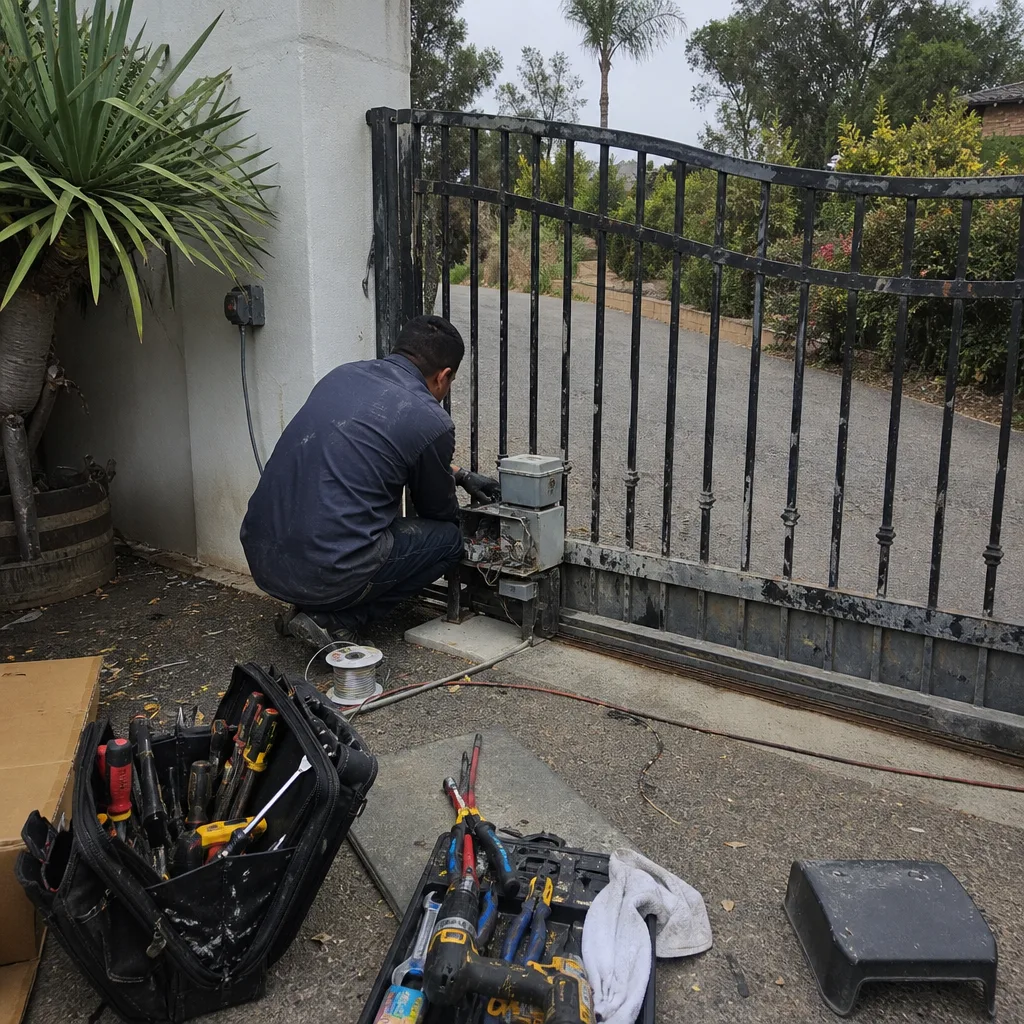 Before
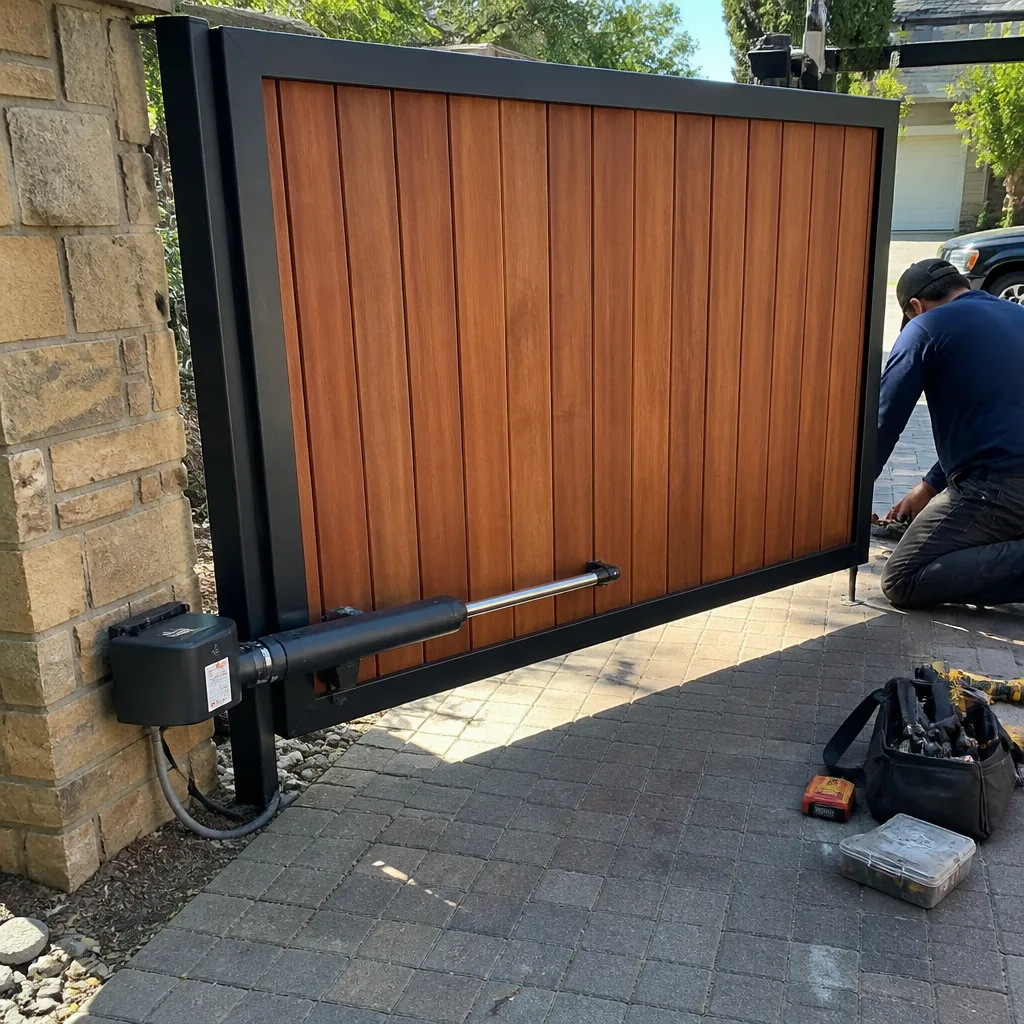 After
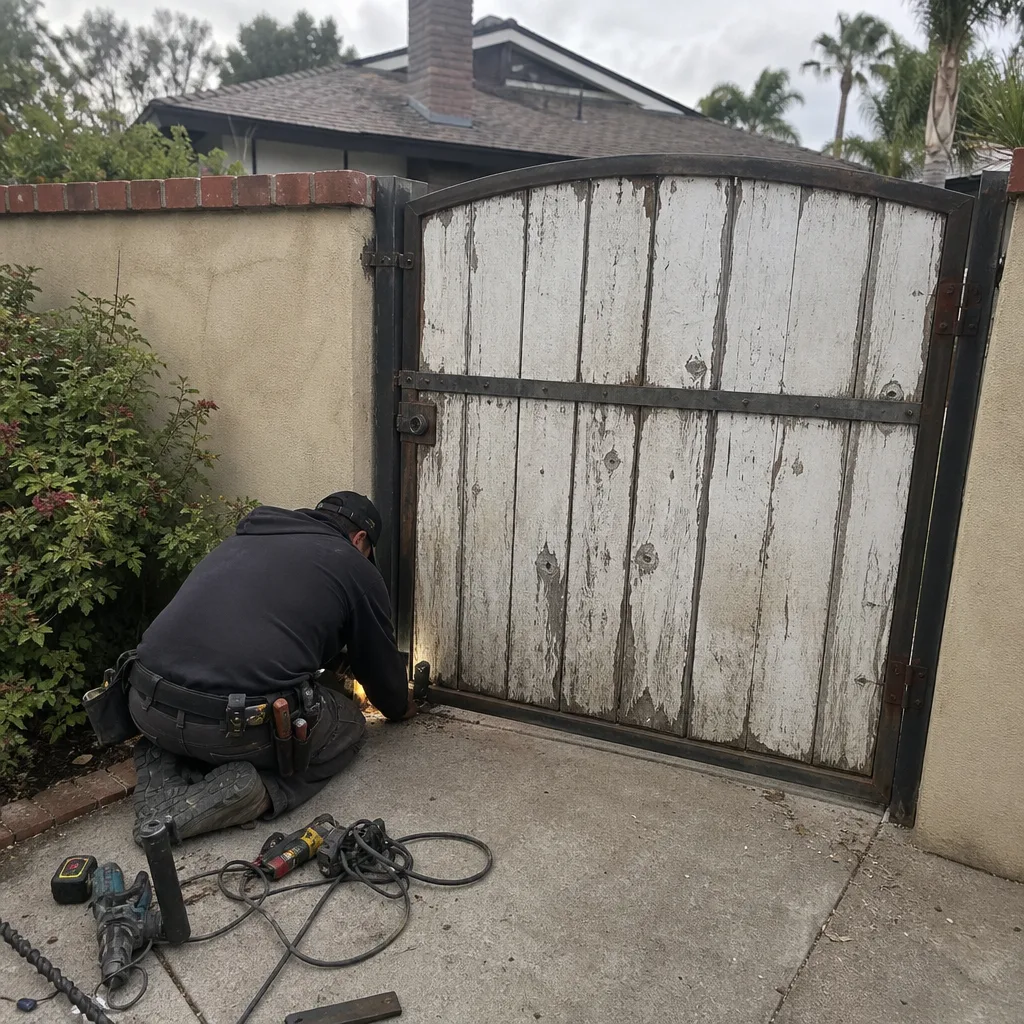 Before
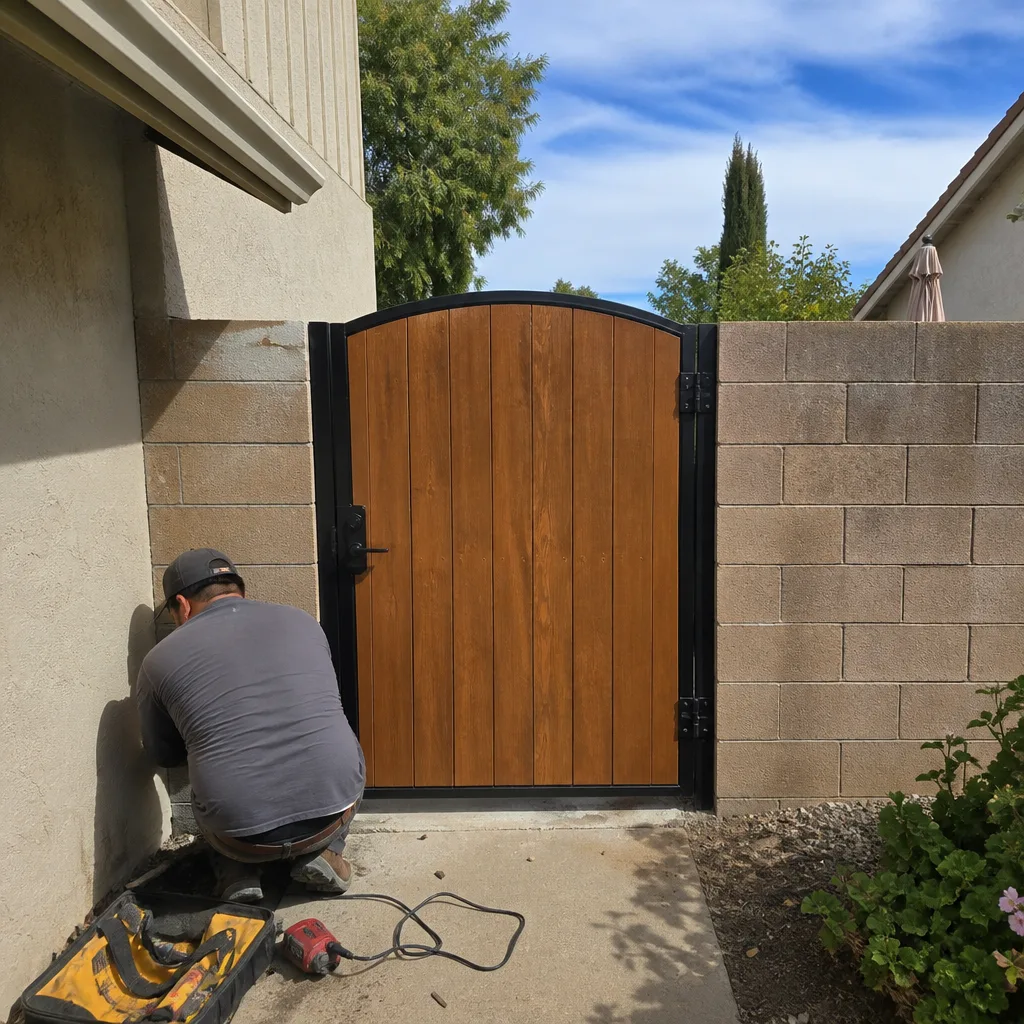 After
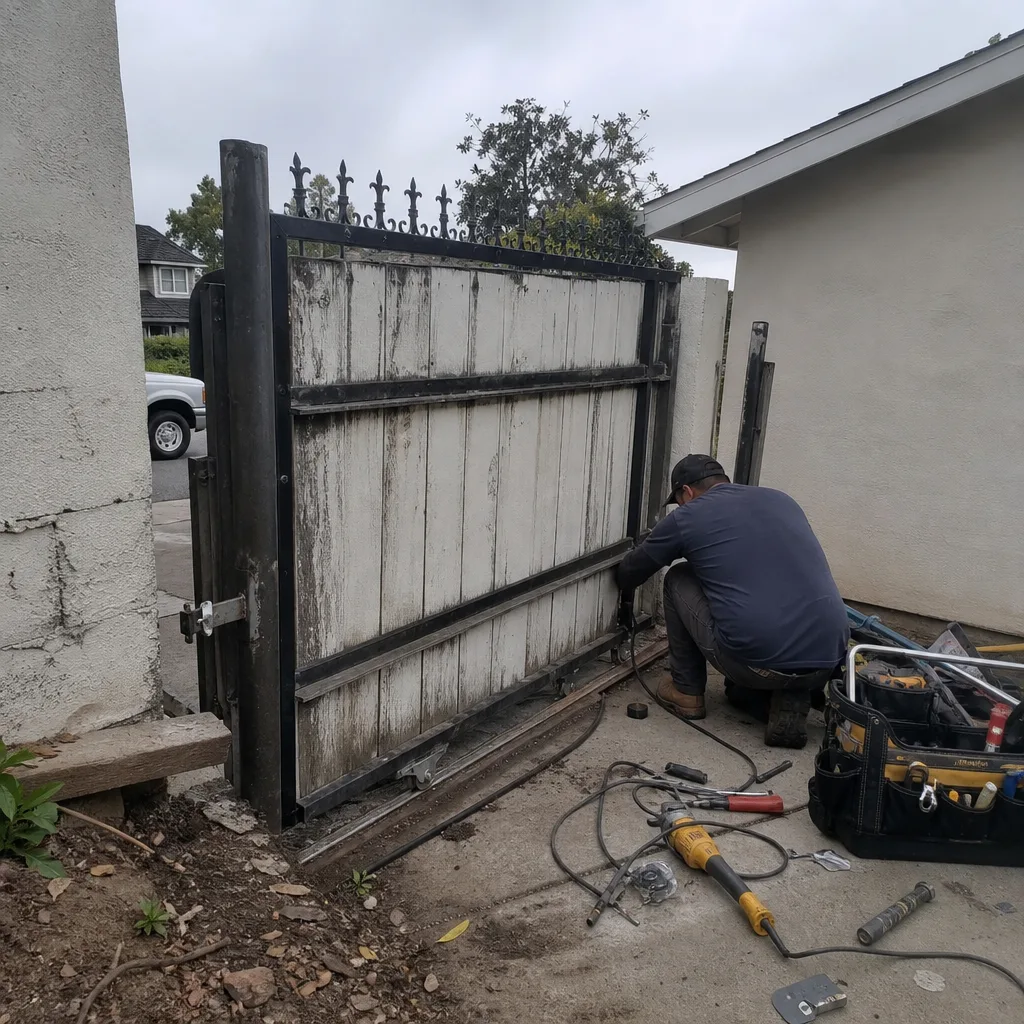 Before
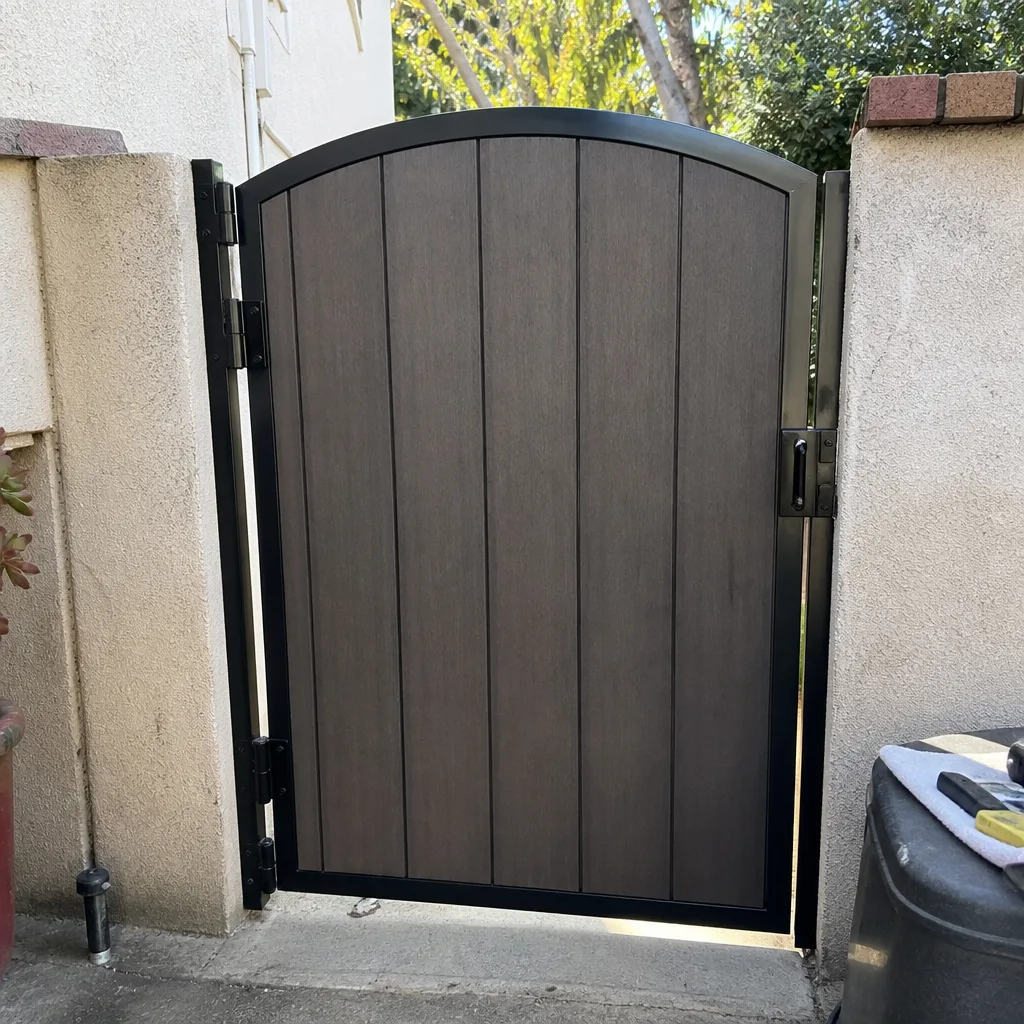 After